Showing posts with label Self Offering. Show all posts

Sunday, 2 July 2023

St John the Evangelist, Burgess Hill Trinity 4 (Wk 13) Eucharistic Sacrifice 2.7.23


Sunday by Sunday we have an invitation to participate in a blessing and distribution of bread and wine that impacts the cosmos through the eucharistic sacrifice of Jesus who died in our place and comes here and now, there and then, to be in our place and that of the whole world before our Father. His institution of the eucharist calls forth obedience - ‘do this in remembrance of me’ - but more profoundly obedient self-offering by ourselves into his own Offering for our salvation and that of the whole world.

When I participate in the eucharist it is like getting on a celestial lift. Though its a brief journey timewise, a few minutes when it comes to specifically pleading Christ’s Sacrifice, I am aware that people and needs already on my heart get lifted to God with powerful consequences. With our patron Saint John I see the lifting of Christ in bread and wine drawing the cosmos to him ‘the bread of God which (also) comes down from heaven and gives life to the world (John 6:33). With Saint Paul I am lifted with Christ through separate consecration and display of bread and wine imagining a showing, a piercing through the Church walls, of divine love to irradiate our suffering world. Our striking west windows expand on Paul’s teaching in 1 Corinthians 11 verse 26, one with a picture of the Crucifixion and the other of the priest at the altar enfolded by the second half of that verse ‘Ye do show the Lord’s death until He comes’. Those who built St John’s were intent it should be less a preaching house and more a temple of God so that what we do this morning is the movement to heaven of Christ’s self offering into which we are drawn, ‘our souls and bodies as a living sacrifice’.


The Old Testament reading today from Genesis 22 is profound and difficult. It is the one used on Good Friday to illuminate the offering of the Son of God upon the Cross. Abraham’s offering of his son, Isaac mirrors God the Father’s sacrifice. It is a difficult passage to read mindful as we are of contemporary abuse and even killing of children by parents and quasi-mentors. The story of how in obedience to God Abraham takes his beloved son and prepares to sacrifice him is graphic. An angel calls back his hand with the knife as it prepares to descend on little Isaac. A ram caught by its horns in a thicket is revealed to replace Isaac as a sacrifice to God. On Good Friday this scripture of a father prepared to offer his son but spared doing so is a pointer to One who actually does so. The profound action of that Day is put into a sentence by Paul two chapters on from today’s second reading: ‘God did not withhold his own Son, but gave him up for all of us’ (Romans 8:32).


For that reason we show the Lord’s death day by day at the altar, as our church windows illustrate. Unlike Abraham God did not withhold his Son for us. Rather, through God's Offering of Christ there is made as the Articles of Religion describe ‘once for all, perfect redemption, propitiation, and satisfaction, for all the sins of the whole world’ (Article 31). God who created the world and human beings in his image, seeing the havoc caused by humans through misuse of free will, provided the remedy once for all. Though that havoc continues it is countered day by day as people come to the Cross for forgiveness, healing and to offer themselves in love to God’s praise and service. This is picked up in our second reading from Romans Chapter 6 where Saint Paul reminds his readers that since they have welcomed the living Christ who has freed them from the power of sin they should live accordingly. Like us, those Roman Christians needed reminding that through Christ’s sacrifice the power of sin had been potentially countered in our lives but our own grateful sacrifice is needed to release the potential of that saving gift. ‘Just as you once presented your members as slaves to impurity and to greater and greater iniquity, so now present your members as slaves to righteousness for sanctification… now you have been freed from sin and enslaved to God, the advantage you get is sanctification. The end is eternal life. For the wages of sin is death, but the free gift of God is eternal life in Christ Jesus our Lord’ (Romans 6:19, 22-23).


At every Eucharist in St John’s we plead Christ’s Sacrifice on Calvary made present among us in Bread and Wine and join to it the sacrifice of ourselves. ‘Pray, my brothers and sisters’ the priest invites ‘that this, my sacrifice and yours, may be acceptable to God, the almighty Father’. ‘May the Lord accept this sacrifice at your hands’ we respond ‘for the praise and glory of his name, for our good, and the good of all his holy Church’. We go on later in the service to offer ‘our souls and bodies as a living sacrifice’. 


Jesus Christ is the same yesterday today and always, across the timespan of creation, the glorious redemption effected upon the Cross displayed in the resurrection, moving on through our own engagement and that of billions, towards the end of history ‘when he will come again in glory to judge the living and the dead’ and make God everything to everyone who accepts his love. To effect today’s Gospel, which presents believers as Christ’s instruments, we need an eye to the once for all Sacrifice of Christ, its renewal in the Eucharist and our own response in self offering. ‘Whoever welcomes you welcomes me, and whoever welcomes me welcomes the one who sent me… and whoever gives even a cup of cold water to one of these little ones in the name of a disciple - truly I tell you, none of these will lose their reward’ (Matthew 10:40, 42) 


Though you’ve been listening to me, I hope, and maybe feel encouraged, St John’s, as our windows warn, is built not as a preaching house but, with its heavenward-pointing spire, as a temple for the worship of God in Burgess Hill. Going to the Eucharist can sometimes be reduced to the spiritual equivalent of going to Waitrose. Whilst I hope you’ll be encouraged by your attendance this morning, it's not what you feel that matters but how real the worship of God has been to you over this hour.  In our church window - do look at it afterwards - the priest faces east to lead the people Godwards. A Waitrose type consumerist approach to the sacred mysteries is suggested by recent liturgical changes - Mass in the round - as well as the obligation to listen and reflect upon the homily or keep quiet after Communion. These helpful elements are geared more to serve our own needs than to what is historically central to the eucharist - the worship of God through pleading the Sacrifice of Christ for the suffering and triumph of the cosmos into which our own renewed self-offering Sunday by Sunday has a key part.


Seeing such profundity beyond the brief action of this hour with scripture and bread and wine has been for me a gift from teaching received and engagement with holy priests and people. Over the course of my life they have lifted for me the veil covering the sacred mysteries, not least my own mother Elsie, who, as my son John is now, was a regular attender at our Wednesday Eucharist. In recognising the power of Christ’s Sacrificial Prayer to which my intentions are joined day by day I have gained confidence in a transformative dynamic summarised in Our Lord’s promise that ‘I, when I am lifted up from the earth, will draw all people to myself’ (John 12:32). All people, but also all things as St Paul writes of all things being ultimately put ‘in subjection under Christ, so that God may be all in all’ (1 Corinthians 15:28). Such ultimately is the power of the eucharist which draws us up to God and out into service of what the Gospel calls ‘the little ones’ of Burgess Hill.


‘May the Lord accept the sacrifice which is yours and mine for the praise and glory of his name, for our good, and the good of all his holy Church’.

Sunday, 13 March 2022

St Mary, Balcombe Lent 2 Christ’s Sacrifice and ours 13.3.22


Jesus said to his disciples: ‘This is my blood of the covenant, which is poured out for many’. Mark 14:24


In this Eucharist we are being caught up into the eternal sacrifice of Christ and its profound challenge to our self-interest.


This gathering in the parish Church is part of an eternal gathering stretching back to Abraham and beyond and stretching forward to the consummation of all things.


This morning we are touching reality - we are drawn to the events represented here which institute God’s covenant with us, and we are drawn into a love which touches every human concern upon the earth.


To the outward eye we are a small gathering of religious people doing their own thing upon their weekly holy day. To the eye of faith we are Christians, caught up once more, on behalf of the whole creation, into the eternal sacrifice of Jesus Christ, through whom,and with whom and in whom in the unity of the Holy Spirit, we give glory to our Father in heaven.


The Old Testament reading from Genesis describes an awesome encounter between Abraham and the Lord. In this holy eucharist we too should be in awe as we approach the same Lord in the Eucharistic sacrifice. This is the Lamb of God who takes away the sins of the world, happy are those who are called to his supper.


One role of a preacher is to awaken, sensitise and draw God’s people afresh into this great mystery of the Christian religion which centres on the Lamb of God our Saviour truly present in the sacrifice and sacrament of the altar. If we fully realised what was going on in this rite our amazement would soon infect others to join in the most significant happening on any day in Balcombe!


Jesus St John says is the lamb slain from the foundation of the world. The sacrifice once offered on Calvary and made present at this altar is rooted in the history of God’s people and the eternal covenant.


Genesis Chapter 15 describes the institution of that covenant with Abraham by the shedding of blood, an agreement between man and God pledging loyalty even unto death.  In the ancient world, when a covenant was ‘cut’ with the slaughter of lambs its breaking could be punishable by death. It also symbolised a death to independent living and the coming alive of a relationship or covenant. In the covenant God made with Abraham there was a special sign.  The sacrificed animals were consumed by a supernatural intervention interpreted as an anticipation of the new covenant.  


As the animal sacrifice was consumed by fire from heaven, so Jesus is to see his body and blood separated in death and then transformed by power from heaven in the glory of the resurrection.


So it is that in the Eucharist we witness the separate consecration of Christ’s body and blood. We pause devotionally on two occasions to recall the sacrificial sundering of the Lamb of God - this is my body...this is my blood...of the new covenant, which is shed for you and for many for the forgiveness of sins


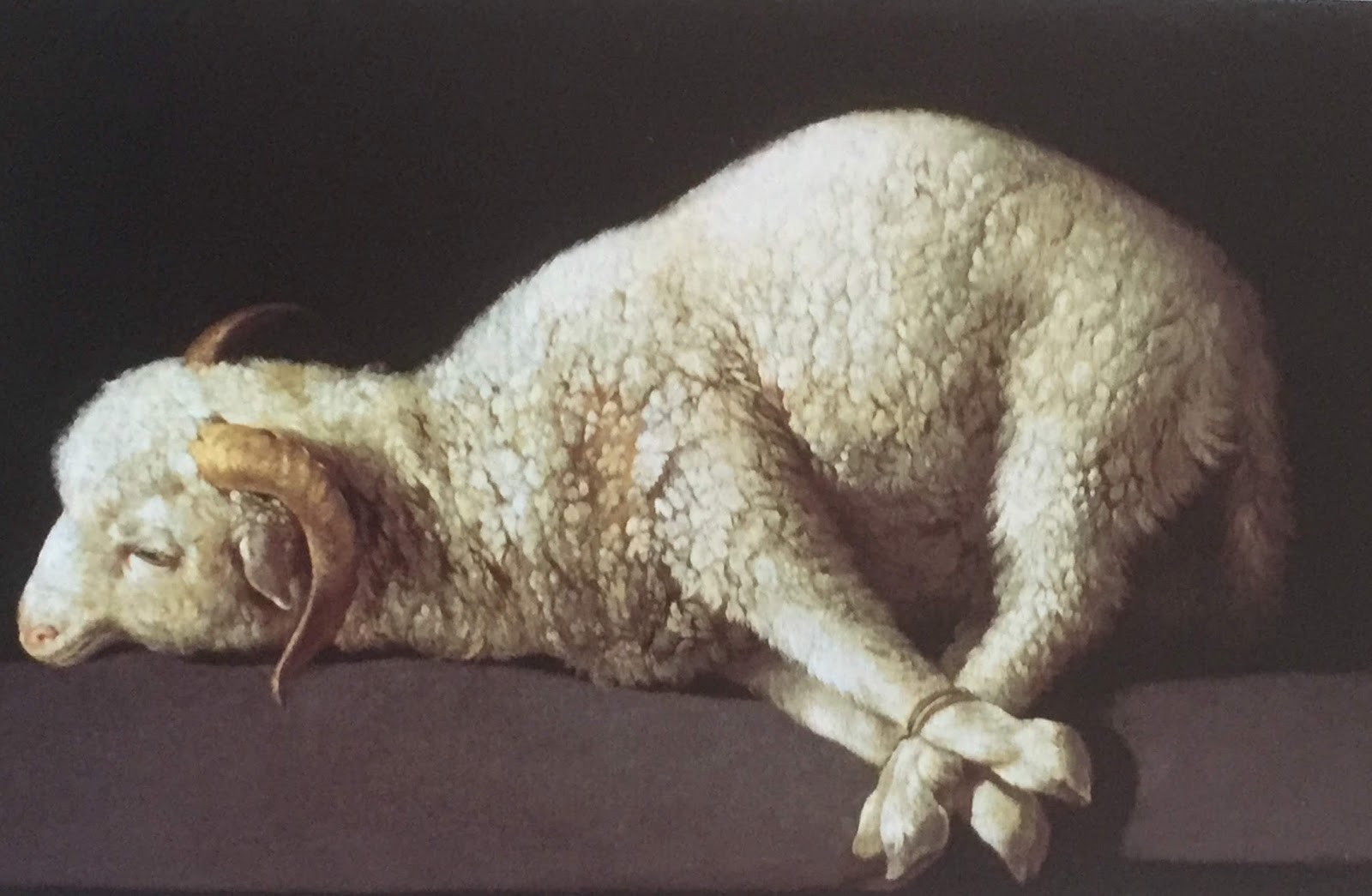
This picture ‘Lamb of God’ is a copy of an oil painting completed between 1635 and 1640 by the Spanish Baroque artist Francisco de Zurbarán. It’s housed in the Prado Museum in Madrid, Spain. It is an image that often appears on Nativity scenes, the Shepherds’ offering which anticipates Christ’s sacrifice.  Jeremy Paxman once wrote of it in the Church Times: ‘no image I know so perfectly captures the astonishing force of the Christian story’.


The sacrificial imagery in today’s Old Testament links to this symbol of Christ as Lamb of God so familiar to us from the liturgy of the Eucharist - familiar and yet often rather empty of meaning to many of us until we examine the Old Testament roots as we are doing this morning.  


How often we hear those words ‘Lamb of God’, linked of course to the Old Testament sacrificial system, illuminated through Abraham in our reading and more especially in the Passover ritual instituted later on by Moses?  How much we need to ‘inhabit the words’ of our prayer and liturgy and not be empty ritualists!


There is a Church in Norway, I’m told, which has the image of a sheep sculpted half way up its tower.  Only when people enter that Church and hear something of its history do they discover the full Christian significance of the sculpted sheep.


Years before the sculpture was erected some renovation work was occurring on the Church steeple in this rural community.  One day a workman slipped from the steeple to almost certain death.  At the same time by a remarkable twist of providence a flock of sheep was being driven past the Church.  


The steeplejack fell on a sheep and his fall was cushioned. The sheep died to save him - an awesome happening! The workers expressed their gratitude to God by adorning that Church tower with a sculpted sheep.


Jesus is the Lamb of God whose voluntary sacrifice takes away our sin.  Our Lord on Calvary takes the full impact of sin and death for us at the cost of his life.


Our Lord has soaked up all the evil that would defeat me and offered me life to the full - life that cancels sin with forgiveness, sickness with healing, bondage with deliverance and even doubt with the gift of faith through the mighty Redemption he has won.  


All of this is powerfully present to me in every celebration of the Eucharist.


I cannot understand it but I will accept it. I cannot understand the way electricity works but that does not stop me switching on the lights. I take both on authority and it works to do so.


Jesus died in my place so that he might live in my place. Jesus died in my place to carry off the impact of evil upon me, through the gift of the Eucharist. Jesus lives in my place, cooperating with my will by his Spirit, as I welcome him again and again into my heart in this Sacrament!


This morning we make the memorial of the Offering of Jesus and enter into that Self-Offering! It is through the sacrificial Lamb of God that we can make a perfect offering to the Father, our sinful bodies made clean by his body..our souls washed through his most precious blood.


There is a deep continuity between the sacrifice of Abraham, the offering of Jesus the Lamb of God, the Eucharistic Sacrifice and our own sacrificial living as Christians.  They all hang together. In a culture so full of self-interest what we are about this morning is powerfully counter-cultural. Here, in union with Christ, we are offering our souls and bodies to be a living sacrifice 


No wonder the eucharist has been described as ‘a meeting of rebels in a mammon-oriented society’. Sacrifice goes against the grain of our contemporary culture in many ways, especially voluntary sacrifice.  People can make sacrifice when absolutely necessary - but to choose to give your life away Sunday by Sunday - well that’s heavily counter-cultural! Faithful attendance and active participation in the eucharist is our great reminder day by day of God’s call for us to direct our energies more and more away from the service of self and more and more towards his service.  This self-offering is, in the words of the Eucharistic Prayer both ‘our duty and our joy’.


Sacrifice is at heart about this voluntary choice about how we direct our lives - it is about love before it is about death.  It is about joyous living just as sure as ‘God loves a cheerful giver’. It is not so much about forgoing what we desire but of binding our energies to what God desires. 


Here in this Eucharist week by week we’re drawn into such a school of sacrifice, into a love which touches every human concern upon the earth. We are caught up again and again into the loving sacrifice of Christ and its profound challenge to our self-interest. In offering our lives once again this morning we’re entrusting them afresh into the hands of God, renewing our covenant with him, so as to be employed to his praise and service in every situation we shall face in the coming week. 

Sunday, 29 August 2021

St John, Burgess Hill Trinity 13. True worship 29th August 2021


I want to think with you this morning about true worship.

The thought is implied in our Gospel from Mark 7 where Our Lord makes a stinging attack on lip service.  He draws on Isaiah: This people honours me with their lips, but their hearts are far from me; in vain do they worship me.

There’s always lots of talk about renewing worship. This, as Jesus says, is primarily about renewing hearts and secondarily about changing outward forms. Impatience with outward form can be godly, but it can also be ungodly. It’s a godly motive to make worship accessible to outsiders. It’s ungodly to make worship bespoke.

Bespoke is all the range. Some of you may be wearing bespoke clothing which has been custom made to your own specification as opposed to being a ready to wear item. Bespoke is no longer just about tailored clothing. It’s about all sorts of things.

Worship though can’t really be bespoke! It’s rather the opposite. The Anglo Saxon means to give worth to something beyond you. Worship is, to quote Evelyn Underhill, the adoring acknowledgment of all that lies beyond us – the glory that fills heaven and earth. It’s very ‘unbespoke’ and hardly consumerist

Worship is about centring on God rather than self though its agenda is mixed.  The word adoration means from the Greek submission and from the Latin ad-oratio, literally, mouth to mouth, the kiss of love.

Renewing worship is about building Godcentred-ness in the church and in individuals through personal prayer. Accessibility is very important. It’s not Christian to be an élite community. Yet, at the heart of Christian worship there is awe before God drawing us to submission and loving devotion. We don’t want our church to be élite and inaccessible but we do want our church to be awesome – awesome, not awful. There’s quite a fine divide here for young people I’m afraid. 

I remember preaching in a church in Lewes where there were a good number of teenagers kneeling with everyone else through the Prayer Book Holy Communion. Talking to them afterwards I learned how they found this traditional worship authentic and intriguing. It intrigued, it drew them to a God beyond this world.

Sometimes we lose confidence in the power of the age old liturgy. People see this loss of confidence in anxious attempts to provide novelty in Church.

Other times, of course, we shirk the duty to make this liturgy accessible. Newcomers to the prayer book get hopelessly lost without page numbers! Our parish eucharist here at St John’s is greatly facilitated by the service booklet though making worship accessible is far more than making the words intelligible. Even the truths of the faith can be made as plain as can be and worshippers, this one included, fail to act on them. This people honours me with their lips, but their hearts are far from me; in vain do they worship me.

The role of the sermon in worship is both to touch on what is awesome, open up some windows to the resurrection world we enter on the Lord ’s Day, and to serve access to scripture. The role of ceremonial around the proclamation of the Gospel and the consecration of the Eucharist is to herald and make accessible the Lord in our midst. If we want to renew worship at St John’s we’re not going to find anything ready built other than what the Lord has provided in word and sacrament and his call for us to participate actively in it. 

Just a suggestion. Free your eyes on occasion from your papers and hymn books. Don’t feel obliged to follow every word in the booklet as if you were word checking a proof. Try closing your eyes or looking up at the east window. When the priest takes, blesses, shows and breaks the elements, watch. Jesus didn’t say read this in remembrance of me – he said do this. The Eucharist isn’t something read out of a book. It’s a sacrificial action. As Christ was taken, broken and shared in his passion so is the bread – and so are you and I. 

The church teaches that there is a change, a real happening, in the worship of the Eucharist. It’s a mysterious change which affects the bread and the wine and the worshipper and the world they come from.

Here is a poem that expresses what I am saying:

I lift this bread/and lift therewith the world, myself and Thee.

Hast Thou not said/‘I, lifted up, will draw the universe to me?’(Martindale)

Attendance at this service is about lifting ourselves and the world on our hearts with Christ to God. I lift this bread and lift therewith the world, myself and Thee.

As the bread is offered at the Eucharist see your life and the lives of all those on your heart as being placed on the altar. As the wine is mixed and offered, see your sorrows and those of the world that are on your heart as being offered. 

Why not look as you sing the offertory song – it’s not just your money that’s going to that altar but your whole life – if you want it so! There’s the rub for you and I!

When the priest says over that bread and wine on our behalf and on behalf of Christ himself This is my body…my blood see your life, your body and blood, taken up into his life and his love.

The love that descends anew upon the Altar, to draw us moth-like, into its celestial flame.

After the words of the Lord and at the end of the Eucharistic Prayer priests lift the consecrated bread and wine upwards as a sign of hat drawing up of that love towards God through with and in Jesus Christ 

True worship is about submission, and the adoring kiss of love. It is about our love for God and God’s for us and our love for one another in the body of Christ.  Accessible worship is worship that helps a congregation see such a vibrant flow of love from their joined hearts through the externals of word and sacrament to God and back. 

There should be enough organisation for people to hear the word and lift up their hearts in the Eucharist but not so much as to distract and deaden things. Priests are there for us but with a brief not to get in the way. They represent Christ, of course, as our two small west windows indicate, one of the cross and one of the priest at the altar. Priests are also, so to speak, midwives, bringing things to birth by coordinating a prayerful liturgy. Part of that birth giving is the call to repentance we have already picked up from today’s gospel about worshipping from the heart. We are also warned of prayerful participation at the Eucharist by St. Paul when he says in 1 Corinthians 11v28 examine yourselves and only then eat of the bread and drink of the cup.

Self-examination has two aspects – negative and positive. As we celebrate the Eucharist we are to do so confessing our sins. We are also to do so, more positively, through offering the Lord all our positive aspirations. Are you there now – before the altar? Are your joys and sorrows, your family and friends, your ambitions and frustrations – have you put them there yet as a living sacrifice?

I lift this bread and lift therewith the world, myself and Thee. Hast Thou not said ‘I, lifted up, will draw the universe to me?’ Coming to the Eucharist is a lot more than taking a piece of blessed bread and sipping consecrated wine. Sometimes the consumerist streak in all of us sees Holy Communion as the important thing – what we get out of the Eucharist. No, it’s what we put in as well! 

True worship is about our souls and bodies being made a living sacrifice with those on our hearts, part of the universe that is ours, being drawn through our devout prayer into true worship of God, into the celestial flame of love which is his, Father, Son and Holy Spirit. Amen.

Sunday, 10 June 2012

Corpus Christi June 10th 2012

Do this in remembrance of me!

"Was ever command so obeyed?

For century after century, spreading slowly to every continent and country and among every race on earth, this action has been done, in every conceivable human circumstance, for every conceivable human need from infancy and before it to extreme old age and after it, from the pinnacles of earthly greatness to the refuge of fugitives in the caves and dens of the earth"
.
Do this in remembrance of me!

"Men have found no better thing to do for kings at their crowning and for criminals going to the scaffold; for armies in triumph or for a bride and bridegroom in a little country church; for the proclamation of a dogma or for a good crop of wheat; for the wisdom of the Parliament of a mighty nation or for a sick old woman afraid to die; for a schoolboy sitting an examination or for Columbus setting out to discover America; for the famine of whole provinces or for the soul of a dead lover; in thankfulness that my father did not die of pneumonia; for a village headman much tempted to return to fetishes because the yams had failed; because the Turk was at the gate of Vienna;

Do this in remembrance of me!

"..for the repentance of Margaret; for the settlement of a strike; for a son for a barren woman; for Captain so-and-so, wounded and a prisoner of war; while the lions roared in the nearby amphitheatre; on the beach at Dunkirk; while the hiss of scythes in the thick June grass came faintly through the windows of the Church;

Was ever another command so obeyed as this?

"Tremulously, by an old monk on the fiftieth anniversary of his vows; furtively, by an exiled bishop who had hewn timber all day in a (Russian) prison camp; gorgeously, for the canonisation of (a Saint) - one could fill many pages with the reasons why men have done this, and not tell the hundredth part of them. And best of all, week by week and month by month, on a hundred thousand successive Sundays, faithfully, unfailingly, across all the parishes of Christendom, the pastors have done this just to make the holy common people of God".
Do this in remembrance of me!

Was ever another command so obeyed as this?
In these immortal words the Anglican monk, Dom Gregory Dix celebrates the awe and wonder of the Holy Eucharist we thank God for this day.

It is primarily an action, "do this"..and it has been done for 2000 years at a million altars. This is a day for standing still and taking stock of this great wonder we celebrate week by week, day by day in St. Giles lest we presume upon the grace we celebrate and receive.

As Dix puts it in his book The Shape of the Liturgy still used in Anglican Theological Colleges "the eucharistic action (is) inextricably woven into the public history of the Western world...the eucharist (has the) power of laying hold of human life, of grasping it...in the particular concrete realities of it..laying hold of them and translating them into something beyond time".

I find great depths in the words of Dom Gregory Dix. Forgive me for reading them at such length. They seemed to me to do as much as any preacher could to set the scene on the Feast of Corpus Christi.

Our Lord Jesus ordained the sacrament of the Eucharist in order that we might be able to join on earth in the pleading of His eternal sacrifice before the face of God the Father.

Then, secondly, that He might feed our souls with His sacred Body and Blood and unite us into One Body, the Church, the Body of Christ, Corpus Christi.

I wonder how many of us would remember or believe or continue to hold fresh in our memories from Confirmation training those facts - I mean: Our Lord giving us the eucharist first to allow us to plead His Memorial Sacrifice and offer our lives with Him to be consecrated lives and then second, second, note, to give us heavenly Food and make us One Bread, One Body?

Or do we rather tend to make our default  the second purpose of the Eucharist? Do we come to Church like we go to Sainsbury’s to get "tanked up" with goodies, so to speak, and to meet our friends?
That should come second. We come first to offer the eucharist - to plead Christ's Sacrifice for the needs of the living and the dead, for others as well as for ourselves.

That long list from Dom Gregory Dix reminded me how all through my life the Eucharist has been a powerful means of sanctifying the lives I minister to, of taking, blessing, breaking sometimes a situation brought on my heart or the people's hearts to the Altar for Christ to carry in Sacrifice to His Father.

As I just quoted from Dix "the eucharist (has the ) power of laying hold of human life, of grasping it...in the particular concrete realities of it..laying hold of them and translating them into something beyond time".

"Laying hold...and translating into something beyond time".

When the Eucharist has been offered for a particular intention there is a profound guarantee that it is "over to the Lord" from there. I felt this recently with Stephen & Victoria Fretten marking their marriage at the parish eucharist, with Alice Batsford last month as we celebrated a eucharist for the dying at the Hospice or as we celebrated that eucharist around Daphne Seidler’s coffin in the Lady Chapel. Last weekend’s Coronation re-enactment included Boy Bishop play acting the Archbishop giving bread and wine to the Queen and Duke at the Coronation eucharist. All are examples of the making holy of life at this service.

Each Eucharist, majestic or simple, pleads Calvary.  Pleads, note, not repeats. Christ died once for all. His death cannot be repeated but his Sacrifice abides for ever. It is that sacrifice he renews before us as he blesses bread and wine through the priest.

"This is my Body...this is my Blood" offered for you to the Father, given to you in Communion. It is a good practice to bow or bend the knee as we come into Church or leave Church, or as we approach or leave the Altar – for there is a special Eucharistic presence. Outside the eucharist, Christ is present, truly present, under the veil of the Aumbry. Even when the altar lights are blown out the light by the Aumbry burns on where the Sacrament is reserved for Communion of the housebound or for our corporate devotion as in the Benediction or blessing given from the consecrated Host at times during evensong. On Monday we were reminded of this symbol of God’s perpetual presence with his people in Horsted Keynes when the Jubilee Beacon was lit from the everlasting Aumbry light.

Incidentally to honour that perpetual presence by bowing or bending the knee when coming and going from before the Aumbry does not deny that presence elsewhere through the reading of Scripture, in Christian Fellowship, in the beauty of nature, in holy people and so on.

Yet mindful of Christ's Presence let us never forget its vital link to the first purpose of every Eucharist, which is action, sacrificial action. The Eucharist is about giving, giving to God. Jesus the Son gives himself in loving Sacrifice. We are to give our lives, our souls and bodies, our needs, our joys, our sorrows, our hopes, our fears, in union with his perfect Offering. Lives so given are lives consecrated, lives transformed by the Gift of the consecrated elements, "The Body of Christ", "Amen", "The Blood of Christ", "Amen".

Through Him, with Him and in Him, then, let us give glory to God the Father in the unity of the Holy Spirit this Corpus Christi Day, confident that God will accept our self offering and as ever give us more than we can ask or imagine in this most Holy Sacrament.