Sunday, 27 March 2022

St John the Evangelist, Burgess Hill Lent 4 27th March 2022

It is a strange paradox that this year’s Gospel for Mothering Sunday is that of the Father’s love. 

It’s not deliberate, just that we’re in the year of Luke and no Lucan passage is more Lent suited than that of the Prodigal Son! The fact Lent 4 is Mothering Sunday is secondary so far as the Lectionary goes. It’s a universal Lectionary and many countries don’t keep Mother’s Day today.


In the story of the Prodigal Son we have a beautiful demonstration of what Lent is all about – the healing joy of repentance.


At its centre is the welcome home of the prodigal. I love the King James Bible version of this story with its rich cadences: 

But when he was yet a great way off, his father saw him, and had compassion, and ran, and fell on his neck, and kissed him. 21 And the son said unto him, Father, I have sinned against heaven, and in thy sight, and am no more worthy to be called thy son. 22 But the father said to his servants, Bring forth the best robe, and put it on him; and put a ring on his hand, and shoes on his feet: 23 And bring hither the fatted calf, and kill it; and let us eat, and be merry: 24 For this my son was dead, and is alive again; he was lost, and is found. And they began to be merry. Luke 15.23-27

What wonderful words! They serve as no other words do to give us an invitation to seek God as our Father.

That paragraph provides the heart of the story involving three characters each of which we may find ourselves identifying with.

First the openness of the prodigal - how ready am I to admit my mistakes? As Christians we believe we are sinners in need of grace. What is so surprising about a sinner sinning?  Yet many of us are slow to seek forgiveness from God or neighbour. Our slowness links to the judgmentalism around typified by the elder brother in the parable whose attitude is far from forgiving! Lent is a time to challenge that judgmental ‘elder brother’ within each one of us. It’s a time to challenge the habitual sins that get on top of us. C.S.Lewis once wrote a caution about despairing over our habitual sins:

I know all about the despair of overcoming chronic temptation.  It is not serious, provided self-offended petulance, annoyance at breaking records, impatience, etc. don't get the upper hand. No amount of falls will really undo us if we keep on picking ourselves up each time.  We shall of course be very muddy and tattered children by the time we reach home.  But the bathrooms are all ready, the towels put out, and the clean clothes in the airing cupboard.  The only fatal thing is to lose one's temper and give it up.  It is when we notice the dirt that God is most present in us: it is the very sign of His presence.  Daily Readings p122-3

The main figure in the Parable is the loving Father who represents God. Jesus teaches God is always helpfully present to us in his holiness and ready to show us the dirt and dysfunction in our lives.  He makes himself present in practical love to remedy our situation - the bathrooms are all ready, the towels put out, and the clean clothes in the airing cupboard.


Our Lord cleanses us of sin and guilt by practical demonstrations geared to our humanity. That’s particularly true of the sacrament of reconciliation also known as sacramental confession in which we play the part of the prodigal in a re-enactment of Luke 15. There is great freedom to be attained through celebrating this sacrament so misunderstood in Anglican circles but familiar to some here at St John’s. If you want to book for this sacrament contact the priest after any service.


The father may represent God but he is also an example of the love a parent, father or mother, is called to show his or her children. Lack of affirmation by parents, lack of generous reconciliation in family life, is the root of much domestic misery.


In Henri Nouwen’s The Return of the Prodigal Son the author speaks of his being inspired by Rembrandt’s famous painting of that title. The gnarled yet welcoming hands of the Father in Rembrandt’s picture symbolise God’s hands stretched out for us upon the Cross. They challenge us to pay the price ourselves for a more affirming attitude to those falling short around us.


The great inspiration of this book is the Christian call to a ministry of affirmation. Be compassionate as your Father is compassionate as Jesus said elsewhere.


As we come to the altar this morning on behalf of ourselves or those on our hearts we come as the prodigal son knowing our need of forgiveness. We come repenting of the ‘elder brother’ in us and all that critical spirit that subtracts from the joy God wants in our hearts. We come finally for grace to be like our Father, capable of love for sinners.


The readiness to treat others as better than they are is simple imitation of God’s readiness to treat us as far better than we are. We can ask the Holy Spirit to build that affirming capacity within us so that we may be better equipped to embrace others as instruments of the divine mercy.


The bathrooms are all ready, the towels put out, and the clean clothes in the airing cupboard.


Bring forth the best robe, and put it on him; and put a ring on his hand, and shoes on his feet: And bring hither the fatted calf, and kill it; and let us eat, and be merry: For this my son was dead, and is alive again; he was lost, and is found. 


Tuesday, 15 March 2022

SS Simon & Jude, West Bank Demerara Evensong ‘Sacrifice’ 15 March 2022


I’m speaking to you from Haywards Heath, a town in between London and Brighton, where I have permission to officiate as a priest across Sussex and London. I also have permission to officiate in the Diocese of Guyana because I have a stall at St George’s having been made a Canon by Bishop Moss in 2013. Some of you know me as a Bible Reading Fellowship author and as a broadcaster on UK’s Premier Christian Radio. Some of my series have been broadcast on Church Calling. My wife Anne and I were married by Fr Edwin Rogers at St Mary’s Yupukari in 1988. My Canonry marked service training Amerindian priests between 1987 and 1990 at the Alan Knight Training Centre, as well as my role for many years as the Bishop of Guyana’s Commissary in the United Kingdom. This year we say farewell to the UK’s Guyana Diocesan Association of which I am acting Secretary. We’re looking forward to a Mass of Thanksgiving for its 90 years of service led by the Bishops of Guyana and Kamarang in July before their attendance at the Lambeth Conference in Canterbury. This broadcast, along with last week’s from Fr Amos, indicate how engagement between the Church of England and the Diocese of Guyana will survive GDA through many personal links, like my own and his, between the two through the friendship and invitation of Fr Ayo. 

How did I get involved in Guyana? Through the late Canon John Dorman who died 18 July 1998 whose ashes are buried in Kamarang and whose name some are thinking of submitting for inclusion in the Calendar of the Church in the Province of the West Indies. Though Fr John was awarded an MBE by Queen Elizabeth his distinction is in another league, that of holiness which the writer Pascal describes as  ‘the most powerful influence in the world’. In 1976 I joined the UK Company of Mission Priests of which John Dorman was a founder member, someone we looked up to as a veteran missionary full of tales of the beauty and peril of Guyana’s interior, though as with all ‘saints’ some found his enthusiasm disconcerting. In social gatherings Canon Dorman was a striking figure with a direct gaze that seemed to go to the heart of each one of us in his company. His evangelical fervour linked to the prayerful anglocatholic faith typical of CMP. His own mission had been fuelled by encountering another holy man of robust faith, Archbishop Alan Knight, who did so much to establish our Diocese.  

In 1985 Canon Dorman wrote to me to share how the Holy Spirit had laid on his heart to write from Guyana asking me to consider continuing the running of a theological college for Amerindian priests, The Alan Knight Training Centre at Yupukari. It was a job for two single priests and married priests were not under consideration. The problem was that though I was in CMP, who make annual promises to stay single, I had been praying about marriage! So it was with some reluctance that I came to see Fr John’s letter as the voice of the Holy Spirit. How could I see the hinterland of Guyana deprived of the eucharist because I wouldn’t leave my comfort zone! 


I needed to go. I went and as I went, in God’s loving kindness, I met Anne, a widow with two young boys. She was at the USPG - United Society for the Propagation of the Gospel’s -  College of Ascension in Birmingham where Fr Allan Buik and I went to train before going to Guyana. Though Anne was going to Argentina to serve in the Anglican diocesan office after she’d served a year there the Bishop of Argentina intervened as he felt the buoys needed a dad. Bishop Randolph, of blessed memory, agreed to our marriage, as did Fr Allan, who I helped Fr Rogers celebrate it on Pentecost Sunday 1988 at St Mary, Yupukari by the Alan Knight Training Centre of which I was Principal. 


It was a great Pentecost Day. The whole village came to the celebration which began with the slaughter of a cow at dawn and cost me a bag of rice, sugar and flour! A Hindu business man I played squash with at Georgetown Club provided a plane to fly in our parents. The Holy Spirit was there working to smooth the logistics of marriage in the jungle! I’m telling you all this because I know the Holy Spirit is the soul of the Church. He is all powerful. He also writes straight through crooked lines as Anne and I have discovered. After the ordinations in 1990 we returned to the UK with the boys where James, our 32 year old youngest son, conceived in Guyana, was born. Since 1990 I have visited the Diocese on six or seven occasions helping training here under the auspices of the Guyana Diocesan Association though I haven’t been over since attending Bishop Davidson’s consecration and enthronement six years ago in March 2016. Since then I’ve been working on a book called ‘Guyana Venture - A Church of England Mission’ commemorating Guyana Diocesan Association framed by my service in the Diocese whilst addressing two centuries of missionary enterprise especially Alan Knight, John Dorman and Derek Goodrich also of blessed memory. Mindful of past failures I’m sharing pride in the Church of England’s venture I have been part of, especially helping raise up priests to serve Guyana’s vast interior, crowned in 2021 by the consecration of Bishop Alfred David. 

Jesus said to his disciples: ‘This is my blood of the covenant, which is poured out for many’. Mark 14:24 [12-26]

In the name of the Father, and of the Son, and of the Holy Spirit. Amen.

My involvement with Guyana links to loving Jesus and desiring to make him loved across the world. In particular loving him through the Eucharist in which we are caught up into his eternal sacrifice of Christ and the profound challenge of that to our self-interest. I could not stand by and miss an invitation to help provide the Eucharist more fully across Guyana’s interior.

This gathering across the world for evensong is part of an eternal gathering stretching back to Abraham and beyond and stretching forward to the consummation of all things. 

Through this evening’s scripture we are touching reality - we are drawn to recall the events represented at the altar Sunday by Sunday, day by day, which institute God’s covenant with us, drawn into a love which touches every concern upon the earth.

To the outward eye we are a small gathering of religious people doing their own thing at evensong or Mass. To the eye of faith we are Christians, caught up once more, on behalf of the whole creation, into the eternal sacrifice of Jesus Christ, most fully at Mass, ‘through whom,and with whom and in whom in the unity of the Holy Spirit, we give glory to our Father in heaven’.

The Old Testament reading from Genesis 15:1-18 describes an awesome encounter between Abraham and the Lord. In the holy eucharist we too should be in awe as we approach the same Lord in the Eucharistic sacrifice. This is the Lamb of God who takes away the sins of the world, happy are those who are called to his supper.

One role of a preacher is to awaken, sensitise and draw God’s people afresh into this great mystery of the Christian religion centring upon the Lamb of God our Saviour truly present in the sacrifice and sacrament of the altar. A Lenten evensong is an excellent opportunity to deepen our appreciation of this staple of our Christian lives Sunday by Sunday. The Lord’s people gather on the Lord’s day in the Lord’s house around the Lord’s table. If we more fully realised what was going on in this rite our amazement would better infect others to join in the most significant happening any day on West Bank, Demerara!

Jesus, St John says, is ‘the lamb slain from the foundation of the world’ (Revelation 13:8). The sacrifice once offered on Calvary and made present at this altar is rooted in the history of God’s people and the eternal covenant.

Genesis Chapter 15 describes the institution of that covenant with Abraham by the shedding of blood, an agreement between man and God pledging loyalty even unto death. In the ancient world, when a covenant was ‘cut’ with the slaughter of lambs its breaking could be punishable by death. It also symbolised a death to independent living and the coming alive of a relationship or covenant. In the covenant God made with Abraham there was a special sign.  The sacrificed animals were consumed by a supernatural intervention interpreted as an anticipation of the new covenant.  

As the animal sacrifice was consumed by fire from heaven, so Jesus is to see his body and blood separated in death and then transformed by power from heaven in the glory of the resurrection. So it is that in the Eucharist we witness the separate consecration of Christ’s body and blood. We pause devotionally on two occasions - bells ring, incense is offered - to recall and honour the sacrificial sundering of the Lamb of God - ‘this is my body...this is my blood...of the new covenant, which is shed for you and for many for the forgiveness of sins’

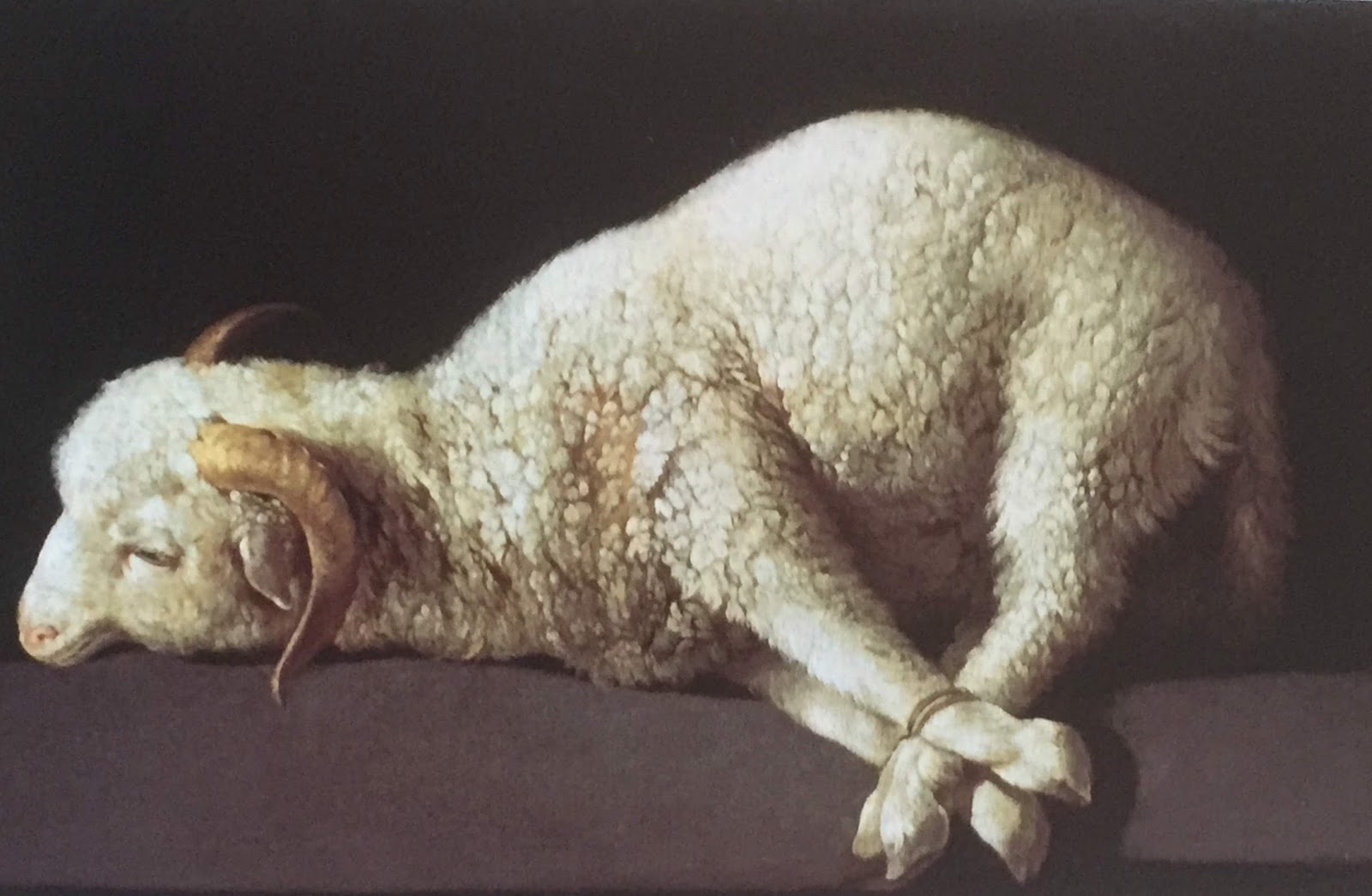
This picture Lamb of God is a copy of an oil painting completed between 1635 and 1640 by the Spanish Baroque artist Francisco de Zurbarán. It’s housed in the Prado Museum in Madrid, Spain. It is an image that often appears on Nativity scenes, the Shepherds’ offering which anticipates Christ’s sacrifice.  Seasoned BBC broadcaster Jeremy Paxman once wrote of it in the Church Times: ‘no image I know so perfectly captures the astonishing force of the Christian story’.

The sacrificial imagery in our Old Testament reading links to this symbol of Christ as Lamb of God so familiar to us from the liturgy of the Eucharist - familiar and yet often rather empty of meaning to many of us until we examine the Old Testament roots as we are doing this evening.  

How often do we hear those words ‘Lamb of God’, linked of course to the Old Testament sacrificial system, illuminated through Abraham in our reading and more especially in the Passover ritual instituted later on by Moses? How much we need to ‘inhabit the words’ of our prayer and liturgy and not be empty ritualists!

There is a Church in Norway, I’m told, which has the image of a sheep sculpted half way up its tower. Only when people enter that Church and hear something of its history do they discover the full Christian significance of the sculpted sheep.

Years before the sculpture was erected some renovation work was occurring on the Church steeple in this rural community.  One day a workman slipped from the steeple to almost certain death.  At the same time by a remarkable twist of providence a flock of sheep was being driven past the Church.  

The steeplejack fell on a sheep and his fall was cushioned. The sheep died to save him - an awesome happening! The workers expressed their gratitude to God by adorning that Church tower with a sculpted sheep.

Jesus is the Lamb of God whose voluntary sacrifice takes away our sin.  Our Lord on Calvary takes the full impact of sin and death for us at the cost of his life.

Our Lord has soaked up all the evil that would defeat me and offered me life to the full - life that cancels sin with forgiveness, sickness with healing, bondage with deliverance and even doubt with the gift of faith through the mighty Redemption he has won.  

All of this is powerfully present to me in every celebration of the Eucharist.

I cannot understand it but I will accept it. I cannot understand the way electricity works but that does not stop me switching on the lights. I take both on authority and it works to do so.

Jesus died in my place so that he might live in my place. Jesus died in my place to carry off the impact of evil upon me, through the gift of the Eucharist. 

Jesus lives in my place, cooperating with my will by his Spirit, as I welcome him again and again into my heart in this Sacrament!

At Mass we make the memorial of the Offering of Jesus and enter into that Self-Offering! It is through the sacrificial Lamb of God that we can make a perfect offering to the Father, ‘our sinful bodies made clean by his body..our souls washed through his most precious blood’.

There is a deep continuity between the sacrifices of Abraham and Moses, the offering of Jesus the Lamb of God, the Eucharistic Sacrifice and our own sacrificial living as Christians.  They all hang together. In a culture so full of self-interest what we are about in Christianity is powerfully counter-cultural. Sunday by Sunday, in union with Christ, we offer ‘our souls and bodies to be a living sacrifice’. 

No wonder the eucharist has been described as ‘a meeting of rebels in a mammon-oriented society’. Sacrifice goes against the grain of our contemporary culture in many ways, especially voluntary sacrifice.  People can make sacrifice when absolutely necessary - I did when I came to Guyana years ago -  but to choose to give your life away Sunday by Sunday - well that’s heavily counter-cultural! Faithful attendance and active participation in the eucharist is our great reminder day by day of God’s call for us to direct our energies more and more away from the service of self and more and more towards his service.  This self-offering is, in the words of the Eucharistic Prayer both ‘right’ and also ‘a good and joyful thing’.

Sacrifice is at heart about this voluntary choice about how we direct our lives - it is about love before it is about death. It is about ‘joyous living’ just as sure as ‘God loves a cheerful giver’. It is not so much about forgoing what we desire but of binding our energies to what God desires. 

In the Eucharist week by week we’re drawn into such a school of sacrifice, into a love which touches every human concern upon the earth. We are caught up again and again into the loving sacrifice of Christ and its profound challenge to our self-interest. In offering our lives we entrust them afresh into the hands of God, renewing our covenant with him, so as to be employed to his praise and service in every situation we shall face in the coming week. 

May such thoughts inspire us as we keep Lent so that our participation in Sunday and weekday Masses comes from hearts aflame with generous love. 

Jesus died in our place so he might live in our place. Jesus died in our place to carry off the impact of evil upon us, through the gift of the Eucharist. 

Jesus would live in our place, cooperating with us by his Spirit, as we welcome him again and again into our heart in the Most Holy Sacrament!

‘This is my blood of the covenant, which is poured out for many’. 

Father, calling to mind the death your Son endured for our salvation.. look with favour on your church's offering.. may your Son make of us a perpetual offering to you and enable us to share with all who stand before you in earth and heaven in songs of everlasting praise: Blessing and honour and glory and power be yours for ever and ever. Amen.

Canon Dr John Twisleton

Diocese of Chichester, Church of England

Former UK Commissary of the Bishop of Guyana and Principal of the Alan Knight Training Centre


Sunday, 13 March 2022

St Mary, Balcombe Lent 2 Christ’s Sacrifice and ours 13.3.22


Jesus said to his disciples: ‘This is my blood of the covenant, which is poured out for many’. Mark 14:24


In this Eucharist we are being caught up into the eternal sacrifice of Christ and its profound challenge to our self-interest.


This gathering in the parish Church is part of an eternal gathering stretching back to Abraham and beyond and stretching forward to the consummation of all things.


This morning we are touching reality - we are drawn to the events represented here which institute God’s covenant with us, and we are drawn into a love which touches every human concern upon the earth.


To the outward eye we are a small gathering of religious people doing their own thing upon their weekly holy day. To the eye of faith we are Christians, caught up once more, on behalf of the whole creation, into the eternal sacrifice of Jesus Christ, through whom,and with whom and in whom in the unity of the Holy Spirit, we give glory to our Father in heaven.


The Old Testament reading from Genesis describes an awesome encounter between Abraham and the Lord. In this holy eucharist we too should be in awe as we approach the same Lord in the Eucharistic sacrifice. This is the Lamb of God who takes away the sins of the world, happy are those who are called to his supper.


One role of a preacher is to awaken, sensitise and draw God’s people afresh into this great mystery of the Christian religion which centres on the Lamb of God our Saviour truly present in the sacrifice and sacrament of the altar. If we fully realised what was going on in this rite our amazement would soon infect others to join in the most significant happening on any day in Balcombe!


Jesus St John says is the lamb slain from the foundation of the world. The sacrifice once offered on Calvary and made present at this altar is rooted in the history of God’s people and the eternal covenant.


Genesis Chapter 15 describes the institution of that covenant with Abraham by the shedding of blood, an agreement between man and God pledging loyalty even unto death.  In the ancient world, when a covenant was ‘cut’ with the slaughter of lambs its breaking could be punishable by death. It also symbolised a death to independent living and the coming alive of a relationship or covenant. In the covenant God made with Abraham there was a special sign.  The sacrificed animals were consumed by a supernatural intervention interpreted as an anticipation of the new covenant.  


As the animal sacrifice was consumed by fire from heaven, so Jesus is to see his body and blood separated in death and then transformed by power from heaven in the glory of the resurrection.


So it is that in the Eucharist we witness the separate consecration of Christ’s body and blood. We pause devotionally on two occasions to recall the sacrificial sundering of the Lamb of God - this is my body...this is my blood...of the new covenant, which is shed for you and for many for the forgiveness of sins


This picture Lamb of God’ is a copy of an oil painting completed between 1635 and 1640 by the Spanish Baroque artist Francisco de Zurbarán. It’s housed in the Prado Museum in Madrid, Spain. It is an image that often appears on Nativity scenes, the Shepherds’ offering which anticipates Christ’s sacrifice.  Jeremy Paxman once wrote of it in the Church Times: ‘no image I know so perfectly captures the astonishing force of the Christian story’.


The sacrificial imagery in today’s Old Testament links to this symbol of Christ as Lamb of God so familiar to us from the liturgy of the Eucharist - familiar and yet often rather empty of meaning to many of us until we examine the Old Testament roots as we are doing this morning.  


How often we hear those words ‘Lamb of God’, linked of course to the Old Testament sacrificial system, illuminated through Abraham in our reading and more especially in the Passover ritual instituted later on by Moses?  How much we need to ‘inhabit the words’ of our prayer and liturgy and not be empty ritualists!


There is a Church in Norway, I’m told, which has the image of a sheep sculpted half way up its tower.  Only when people enter that Church and hear something of its history do they discover the full Christian significance of the sculpted sheep.


Years before the sculpture was erected some renovation work was occurring on the Church steeple in this rural community.  One day a workman slipped from the steeple to almost certain death.  At the same time by a remarkable twist of providence a flock of sheep was being driven past the Church.  


The steeplejack fell on a sheep and his fall was cushioned. The sheep died to save him - an awesome happening! The workers expressed their gratitude to God by adorning that Church tower with a sculpted sheep.


Jesus is the Lamb of God whose voluntary sacrifice takes away our sin.  Our Lord on Calvary takes the full impact of sin and death for us at the cost of his life.


Our Lord has soaked up all the evil that would defeat me and offered me life to the full - life that cancels sin with forgiveness, sickness with healing, bondage with deliverance and even doubt with the gift of faith through the mighty Redemption he has won.  


All of this is powerfully present to me in every celebration of the Eucharist.


I cannot understand it but I will accept it. I cannot understand the way electricity works but that does not stop me switching on the lights. I take both on authority and it works to do so.


Jesus died in my place so that he might live in my place. Jesus died in my place to carry off the impact of evil upon me, through the gift of the Eucharist. Jesus lives in my place, cooperating with my will by his Spirit, as I welcome him again and again into my heart in this Sacrament!


This morning we make the memorial of the Offering of Jesus and enter into that Self-Offering! It is through the sacrificial Lamb of God that we can make a perfect offering to the Father, our sinful bodies made clean by his body..our souls washed through his most precious blood.


There is a deep continuity between the sacrifice of Abraham, the offering of Jesus the Lamb of God, the Eucharistic Sacrifice and our own sacrificial living as Christians.  They all hang together. In a culture so full of self-interest what we are about this morning is powerfully counter-cultural. Here, in union with Christ, we are offering our souls and bodies to be a living sacrifice 


No wonder the eucharist has been described as ‘a meeting of rebels in a mammon-oriented society’. Sacrifice goes against the grain of our contemporary culture in many ways, especially voluntary sacrifice.  People can make sacrifice when absolutely necessary - but to choose to give your life away Sunday by Sunday - well that’s heavily counter-cultural! Faithful attendance and active participation in the eucharist is our great reminder day by day of God’s call for us to direct our energies more and more away from the service of self and more and more towards his service.  This self-offering is, in the words of the Eucharistic Prayer both ‘our duty and our joy’.


Sacrifice is at heart about this voluntary choice about how we direct our lives - it is about love before it is about death.  It is about joyous living just as sure as ‘God loves a cheerful giver’. It is not so much about forgoing what we desire but of binding our energies to what God desires. 


Here in this Eucharist week by week we’re drawn into such a school of sacrifice, into a love which touches every human concern upon the earth. We are caught up again and again into the loving sacrifice of Christ and its profound challenge to our self-interest. In offering our lives once again this morning we’re entrusting them afresh into the hands of God, renewing our covenant with him, so as to be employed to his praise and service in every situation we shall face in the coming week. 

Sunday, 27 February 2022

St John the Evangelist, Burgess Hill Pre-Lent Sunday 27 February 2022

And while he was praying, the appearance of his face changed, and his clothes became dazzling white…(and) a cloud came and overshadowed them Luke 9 

Years back when I was a student at Oxford a coach taking pilgrims from my church, St Mary Magdalene’s, to the Shrine of Our Lady at Walsingham crashed and someone died. The Sunday afterwards the parish priest preached his sermon with reference to this Gospel and I will never forget Fr Hooper’s sermon.

He presented to us, as I now present to you, how the mystery of the glorious Transfiguration is set under the dark cloud.  After Our Lord’s clothes became dazzling white… St Luke records a cloud came and overshadowed them.

As we gathered in St Mary Mags that Sunday we were reminded how God’s glory can shine brightest of all through the cloud of bereavement. We gather Sunday by Sunday to celebrate the glory of the risen Lord with pain, the pains of the church and its divisions, of the world in its godforsakenness, especially with the invasion of Ukraine and the pains of those of in our circle which are most inscribed on our hearts. Then - the glory of the Lord shines over us as we take, bless, break and share bread!

Christianity is about suffering and the supernatural - these are the two things that keep us close to Christ - the two things Lent reminds us of.

We the baptised are a dying and rising people of a dying and rising Lord.

We are a people losing ourselves to gain the Holy Spirit.

Paul expresses this beautifully in the second reading: ‘All of us, with unveiled faces, seeing the glory of the Lord as though reflected in a mirror, are being transformed into the same image from one degree of glory to another; for this comes from the Lord, the Spirit’ (2 Corinthians 3:18)

Made in his image we are being transformed into his selfless likeness …from glory to glory.

Made to know ourselves, love ourselves and forget ourselves - a good motto for Lent! Know yourself, love yourself, forget yourself’ 

Know yourself - for that is the other side of the coin to knowing God. 

Love yourself - as you recognise again and again how much you are loved by God who made you. Then - and here is the struggle - forget yourself as Christ forgot himself on Calvary so he could die and rise and give us the Holy Spirit!

Most of the trouble in the world is caused by people unprepared to forget themselves, people wanting instead to be important as seems the case with President Putin. 

As Raniero Cantalamessa writes: ‘70% of the human body is made up of water, but perhaps even more than 70% of man’s spirit is made up of pride...We all long to be noticed. If we could visualise the whole of humankind as it appears in the eyes of God, we would see the spectacle of an immense crowd of people all standing on tiptoe, all pushing one another in the attempt to make themselves seen and all shouting, ‘I’m here too, I’m here in the world too!’. All this pride is, of course, just smoke that death dissipates day by day. ‘Vanity of vanities’...but its consequences are...dreadful’.

There is so much wastage in life and that does not exclude the Christian life. So much of our energy, even though we be Christians, gets dissipated in the instinctive serving of our desires or attending to our fears. The energy we put into this subtracts from all we are able to offer the Lord for building his kingdom. Our Lord needs more of our energies directed to his ends and not our own, our wills more and more directing our lives to his praise and his service.

Self-forgetfulness is a real gift of God which balances self-worth and self knowledge. I find that juggling around with these three is what the deepening of spirituality is all about. The supernatural and suffering play their part as well from God’s side…

Sometimes we need to know ourselves better, sometimes to pay attention, to be kind and loving to ourselves. There are times to concentrate and affirm the self. There are many other times when we are best off getting to work on forgetting ourselves.

As we approach Lent the Church presents to us in today’s scripture the radiant and transfigured humanity of Christ illuminated and filled right through with the life of God coupled to the invitation to be transformed likewise into a heavenly new creation. 

The Transfiguration of Christ preceding his death and resurrection provides disciples then and now insight into the beauty, glory and wondrous life of the world to come and courage to keep heading there. We are not there yet but rather in the vale of tears yet sufferings in that vale are destined to be lost in the ultimate praise and glory of heaven. 

We are the dying and rising people of a dying and rising Lord, a people losing ourselves to gain the Holy Spirit, made in his image to be transformed into his selfless likeness …from glory to glory, made to know ourselves, love ourselves and forget ourselves…so Christ may shine in us now and always! 

A happy and holy Lent!

Saturday, 26 February 2022

Revd Eve Wiseman College of St Barnabas, Lingfield 1130am 20-2-22

Introduction to Requiem 

We are gathered in Chapel to give thanks to God and to pray for Eve Wiseman. We have come from near and far to salute a friend and priest whose passing leaves us all the poorer. Weeks back I was at the altar with Eve and many of you to pray for Derek Goodrich and months back, again with Eve, for our mutual friend and former resident Allan Buik. Now for this eucharist Eve herself is on the other side in this celebration as her picture by the Paschal Candle reminds us. In penitence and faith therefore let us prepare to celebrate the sacred mysteries central to our life as Christians, central to Eve’s life and ministry, welcoming through them a pledge of the glory which is to come.

Sermon                                                            Romans 8:35-39

I know that my Redeemer lives, and that at the last he will stand upon the earth; and after my skin has been thus destroyed, then in my flesh I shall see God, whom I shall see on my side, and my eyes shall behold, and not another. Words dear to Eve from Job Chapter 19 verses 25 to 27

In the name of the Father, and of the Son and of the Holy Spirit. Amen.

Eve Wiseman died January 8 a few days after suffering a stroke. My wife Anne prayed with her just before she was taken from College to hospital. Eve is survived by her niece, Helen Clay of Caernarfon, Wales and nephew, Simon Clay of Vancouver.

Eve was born near here in Coulsdon, baptized at St. Francis Church and confirmed at St. Andrew’s Church. As a child, she was awarded a scholarship to Purley County Grammar School for Girls. She studied for her school certificate and higher school certificate at London University, and went on to obtain a Teaching Certificate from Cambridge’s Homerton College. Her main subjects were physical education and educational psychology. Eve taught for four years on Cable Street in Stepney, London, in the school in which “To Sir With Love” was based. 


Eve had a distinguished academic career. She obtained a Master of Education from Western Washington State College in Bellingham and a Master of Divinity from the Vancouver School of Theology. She lectured and taught at CF Mott Training College in Liverpool, the University of Birmingham’s Faculty of Education and was an associate professor at Western Washington University. In the 1970s she was considered one of the top ten experts in the field of movement education in the United States. Eve once said that “a child dancing is often worshipping God”. She also coached the women’s field hockey team at Western Washington University as well as being on the Senate there and later at Vancouver School of Theology. Eve spoke at conferences and seminars around the world.


She was ordained to the diaconate in 1984, and to the priesthood in 1985 by Archbishop Douglas Hambidge. Prior to ordination she had been active at St. James, Vancouver and St. John, Shaughnessy. In the late 1970s she served as a lay minister at Nooksack Indian United Methodist Church near Bellingham.  


As a student, deacon and priest Eve held positions in many parishes in the Canadian Diocese of New Westminster including St. Matthew, Abbotsford; St. Francis in-the-Wood, West Vancouver; St. Richard, Norgate; St. Mary, Galiano Island; St. Christopher, West Vancouver;  St. Thomas, Chilliwack and St. David, Tsawwassen. She was Rector of St. Anne, Steveston from 1988-1992. Eve was deeply involved in Healing Ministry. It was always a joy to pray with her, so warm and so convinced of the power of God.


After Eve’s retirement in 1996, she had a number of “House for Duty” appointments including Ullapool (Northwest Scotland) and Scotshouse (Irish Republic) and as interim priest at the Parish of Thurso and Wick in the Scottish Episcopal Church in 2000 and 2001. She then settled more permanently in England where she occasionally presided and preached at St. John the Baptist, Hove, at her local church, St. Peter, Henfield near Terry’s Cross, The Point and here at the College.


Eve was generous to many of us including Anne and I who enjoyed visiting her house near Corinth and discussing with her the ins and outs of deacon Phoebe. An avid gardener, a voracious reader, she loved music and loved to sing so it's good we can sing this morning as part of her Christian farewell. 

There is one thing and one alone that is stronger than death - the love of God which is in Christ Jesus our Lord. 

As St. Paul wrote in the passage Anne read, 'neither death, nor life...nor things present, nor things to come...nor anything else in all creation, will be able to separate us from the love of God in Christ Jesus our Lord’.

Christians believe God himself has entered our human condition to live and die, a man like us in all things but sin. 

We believe that by dying Christ destroyed the power of death, and by rising again opened up a new and imperishable life to all believers.

The love of God in Jesus - this and this alone is stronger than death. When the Spirit of Jesus comes into our lives we know this for sure. As the Lord said himself, the very hairs on our head are numbered - God, the very source of life, cares for us all with an infinite love, a love stronger than death.

We commend Eve to God with this faith, faith built upon the Risen Christ. There alone, in the love of Jesus, is a sure foundation that death cannot shake.

Yet we should not presume upon that love

As we come to say farewell to Eve purple vestments challenge us to remember our own mortality. As our friend has departed this life, so most certainly must we, and which of us knows the day or the hour the Lord has for them?

Scripture makes plain the need to prepare for that day. The surest preparation comes as we welcome the love of Jesus into our lives. This is the sure way to a purpose for living and a reason for dying.

Gathering with the Lord's people around the Lord's Table fits us to gather in our eternal homeland, in the house of the Lord for ever

Come close to God, scripture says, and he will come close to you!

Today as we come close we have the people of Ukraine on our hearts. Let us not doubt that God sees that concern and through the eucharist will impact that perilous situation as we come to him this morning.

Commit your way to him and he will act for you, in this life and the next!

God immerse you in his endless love through this eucharist, strengthen in you the hope of heaven and grant the soul of Eve Wiseman purification for the vision of himself. 

Eternal rest grant unto her, O Lord - and let light perpetual shine upon her!

Prayers

Priest:    For our sister Eve, let us pray to the Lord Christ who said ‘I am the Resurrection and I am Life’.

Reader: Lord, you consoled Martha and Mary in their distress: draw near to us who mourn Eve and dry the tears of those who weep.

All    Hear us, Lord.

You wept at the grave of Lazarus, your friend, comfort us in our sorrow.

All    Hear us, Lord.

You raised the dead to life: raise our sister Eve, to eternal life

All    Hear us, Lord.

You promised paradise to the thief who repented: bring our sister Eve to the joys of heaven

All    Hear us, Lord.

Our sister Eve was washed in baptism and anointed with the Holy Spirit. Give her fellowship with all your saints.

All    Hear us, Lord.

Eve celebrated your mysteries and was nourished with your body and blood. Grant her a place at the table in your heavenly kingdom.

All    Hear us, Lord.

We pray your blessing upon the churches and communities dear to Eve: St. Francis and St. Andrew, Coulsdon; St. James, Vancouver and St. John, Shaughnessy; Nooksack Indian United Methodist Church; St. Matthew, Abbotsford; St. Francis in-the-Wood, West Vancouver; St. Richard, Norgate; St. Mary, Galiano Island; St. Christopher, West Vancouver;  St. Thomas, Chilliwack and St. David, Tsawwassen; St. Anne, Steveston;  Ullapool in Scotland and Scotshouse in the Irish Republic, the Parish of Thurso and Wick in Scotland; St. John the Baptist, Hove; St. Peter, Henfield; Terry’s Cross; The Point and we pray a blessing upon our life together here at the College.

All    Hear us, Lord

Let us commend Eve to the prayers of the holy Mother of God, St Barnabas, deacon Phoebe and all the saints as we pray in our own words keeping silence: 

Reader: Merciful Father,  

All        accept these prayers for the sake of your Son our Saviour Jesus Christ. Amen